Cooling
The world now needs more energy to cool homes than to heat them
For the first time, the International Energy Agency says global cooling needs are overtaking those for heating. Britain is a long way behind that curve, but its summers are catching up — and cooling can move in time just as heating can.
This week the International Energy Agency published its World Energy Outlook. One line in it would have sounded unlikely a decade ago: "for the first time in energy history, global cooling needs are overtaking those for heating."
Most of that growth is in hot countries where incomes are rising and air conditioners are becoming affordable. Outside China, the IEA says, 85% of households in emerging and developing economies are exposed to high temperatures, and fewer than 20% of them have an air conditioner yet. In its main scenario, electricity used for cooling grows by 1,700 terawatt-hours by 2035. If heatwaves become stronger and more frequent, it adds another 700 terawatt-hours, with what the IEA calls "particularly strong implications for peak demand".
Britain is still a heating country
In Britain, heating still dominates. A University of Reading study of the English Housing Survey found that 4.3% of homes in England use air conditioning — about 1.06 million homes. A Uswitch survey puts the UK figure above four million, but more than half of those are portable units.
The summers are changing faster than the homes. The Met Office says summer 2026 was provisionally the UK's hottest on record, with a mean temperature of 16.5°C, beating the record set only a year earlier. Temperatures peaked at 38.2°C at Hartpury College on 13 August. Met Office scientists estimate that climate change made a summer like it around 130 times more likely.
The first answer to a hot home is still the building. As we wrote in the summer, the cheapest energy is the energy your home doesn't need: shading, insulation and night-time ventilation can keep a home much cooler without any machine at all. But not every home can be fixed that way, and the people most at risk from heat are often the least able to cool down. The Reading study found that homes with someone over 75 use air conditioning least.
The heat pump that also cools
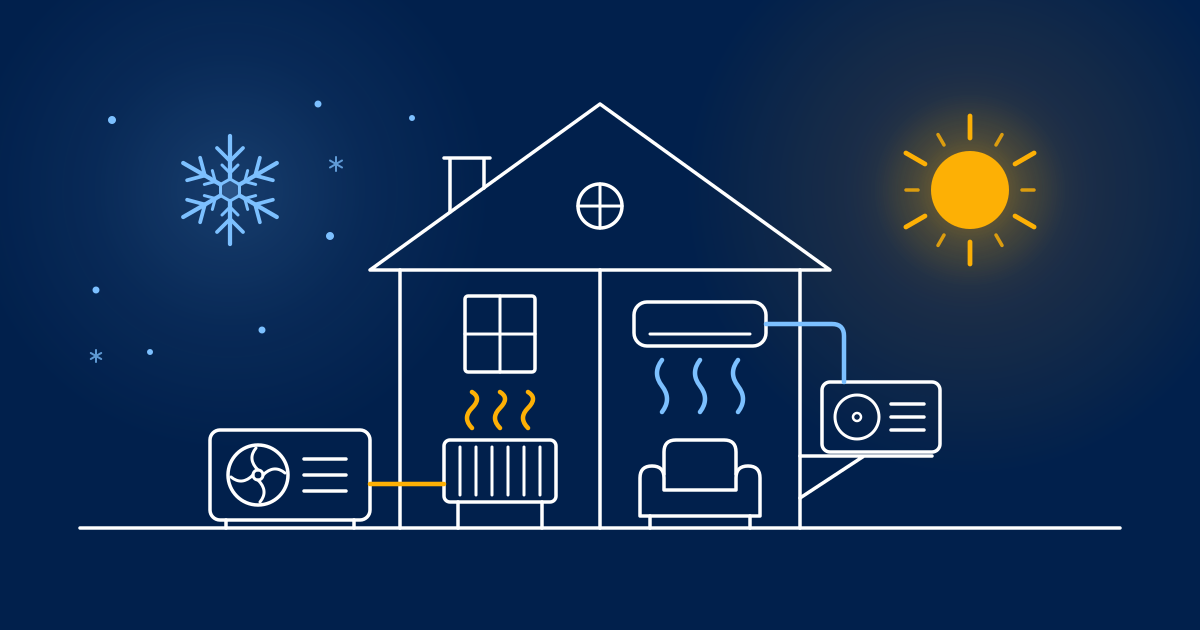
Many British homes will get cooling as a side effect of replacing their heating. An air-to-air heat pump moves heat into a room in winter and out of it in summer. In England and Wales, the Boiler Upgrade Scheme now offers a £2,500 grant towards one.
That makes cooling another electrical load in the home, alongside the car, the battery and the hot-water cylinder. Like heating, it is load that can move.
Cooling can move in time too
A home stores warmth in its walls, floors and furniture. That is why a heat pump can warm a suitable home a little earlier, when electricity is cheaper, and let it coast through an expensive evening. The same thermal mass works in reverse in summer.
On a sunny day, half-hourly tariffs often have their lowest prices around midday, when solar panels across the country are producing the most. In a hot spell, the house keeps warming up into the evening, just as the sun drops and prices rise. If the home is cooled a little more while electricity is cheap or a household's own solar panels have power to spare, it can carry that cool into the evening and run the unit less when electricity is expensive.
The idea is the same as pre-heating, with one difference: the limit that matters is the top of the comfort range rather than the bottom. Neither limit should be negotiable. A home that overheats is a health risk, especially for older people and babies, in the same way that a cold home is.
Where Wiggle fits
Wiggle is being built to plan a home's heating and cooling around the temperatures the household chooses for each part of the day. If a heat pump or air conditioner can cool, the same planning that warms the home ahead of a cheap period in winter can cool it ahead of a hot evening in summer, while the household's chosen range stays protected at both ends.
Cooling is still new to most British homes, and we will be learning how they behave in summer from the households who join our pilot. The aim is the same in both seasons: use only the energy the home needs, then move the flexible part to better times.
Sources and further reading
- International Energy Agency: World Energy Outlook 2026, executive summary
- Met Office: Summer 2026 provisionally hottest on record for the UK
- University of Reading: The most at risk from heat have the least air con
- Uswitch: Four million UK homes now have air conditioning
- GOV.UK: Notice of approved grant categories and values for the Boiler Upgrade Scheme